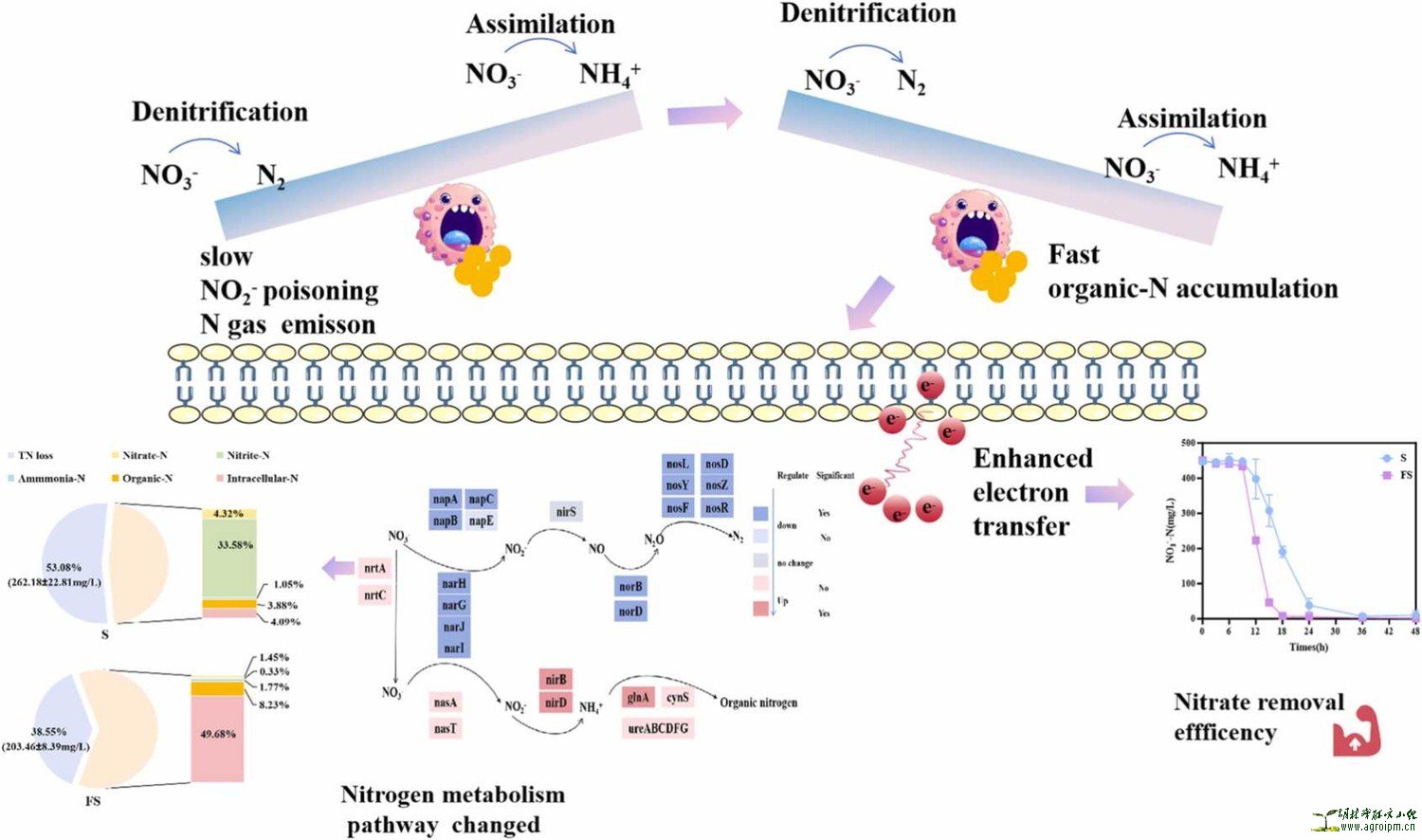
Nitrates are the primary anion resulting in soil secondary salinization. However, microbial denitrification is limited in soil remediation due to its slow removal rate, production of toxic by-products, and nitrogen loss. In this study, we first found that fucoidan significantly enhanced the growth and nitrate removal efficiency of
Stutzerimonas frequens S4 as an exogenous nutrient stimulant. Compared to the control group, the nitrate removal efficiency increased by 58.62% and the removal rate increased from 28.64 mg/L/h to 48.42 mg/L/h from 9 to 18 h. The mechanism research found that the increase in removal rate was closely related to enhancement of electron transfer activity promoted by fucoidan, while the upregulation of metabolic pathways such as purine, nucleic acid, and cofactor production provided energy for microbial growth and denitrification. Additionally, fucoidan could regulate the nitrate conversion pathway, increasing the ratio of nitrate assimilation which leads to reduced emissions of nitrite and gases, and elevated levels of organic and intracellular nitrogen. Transcriptomic studies have shown that fucoidan achieves these effects by significantly inhibiting denitrification genes and upregulating assimilation-related genes. This study elucidates how fucoidan enhances microbial nitrate removal, offering new insights for its application in remediating secondary salinization soil.
硝酸盐是导致土壤次生盐渍化的主要阴离子。然而,由于去除速率缓慢、产生毒性副产物以及造成氮素损失,微生物反硝化作用在土壤修复中的应用受到限制。本研究首次发现,褐藻糖胶(fucoidan)作为外源营养刺激剂可显著促进施氏假单胞菌(Stutzerimonas frequens)S4的生长并提高其硝酸盐去除效率。与对照组相比,9–18 h内硝酸盐去除效率提升了58.62%,去除速率由28.64 mg/L/h提高至48.42 mg/L/h。机制研究表明,去除速率的提升与褐藻糖胶促进的电子传递活性增强密切相关;同时,嘌呤、核酸及辅因子合成等代谢通路上调,为微生物生长及反硝化作用提供了能量。此外,褐藻糖胶可调控硝酸盐转化通路,提高硝酸盐同化比例,从而减少亚硝酸盐及气态氮素的排放,并提升有机氮和胞内氮水平。转录组学分析显示,褐藻糖胶通过显著抑制反硝化功能基因并上调同化相关基因实现上述效应。本研究阐明了褐藻糖胶增强微生物硝酸盐去除能力的分子机制,为其在次生盐渍化土壤修复中的应用提供了新的理论依据。