 https://onlinelibrary.wiley.com/doi/10.1002/app.58182
ABSTRACT: This study developed chitosan-based hydrogels as field-deployable carriers for sustained fungicide delivery to enhance crop disease resistance and yield. Citral and chitosan were reacted at three molar ratios (N1, N1.5, N2) via acid-catalyzed Schiff-base condensation, and the resulting hydrogels were characterized by FTIR, 1H NMR, SEM and WXRD. Structural analyses confirmed the formation of self-ordered imine clusters with a d-spacing of 20.5 Å stabilized by non-covalent interactions. N1, the highest-cross-linked hydrogel, showed the best thermal stability (T10 = 160°C) and the lowest swelling, releasing 7.0% slower than N1.5 and 37.9% slower than N2. Antifungal assays demonstrated that N1 provided the strongest inhibition against five phytopathogens (Rhizoctonia solani, Fusarium graminearum, Botrytis cinerea, Rhizoctonia cerealis, and Phytophthora capsici), improving inhibition of B. cinerea, P. capsici, and F. graminearum by 56.8%, 82.9%, and 181.3%, respectively, compared with free citral. These hydrogels combine antifungal activity, water retention, thermal stability and controlled release, providing a promising strategy for green fungicide delivery in agriculture.
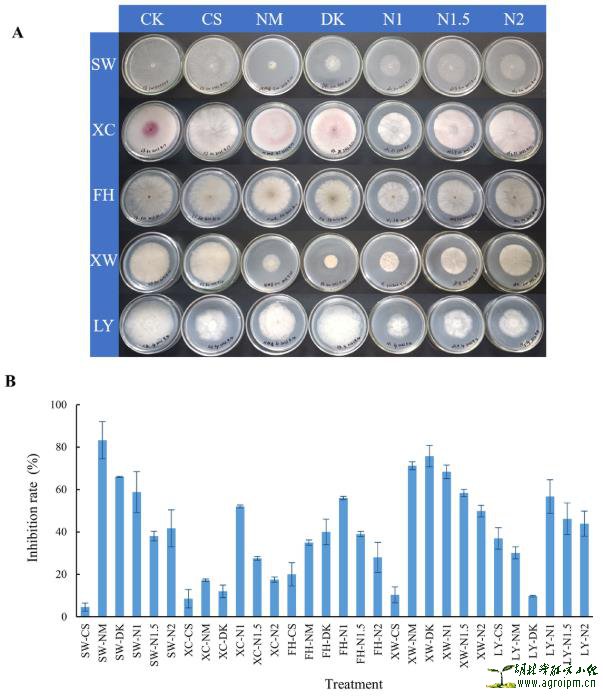
Antifungal assay results: (A) fungal growth after treatment; (B) inhibition rates at 48 h (CK: control; CS: chitosan; NM: citral; DK: polymyxin; N1, N1.5, N2: citral hydrogels; SW: R. solani; XC: F. graminearum; FH: B. cinerea; XW: R. cerealis; LY: P. capsica).