The retention factor, or Rf, is defined as the distance traveled by the compound divided by the distance traveled by the solvent.

For example, if a compound travels 2.1 cm and the solvent front travels 2.8 cm, the Rf is 0.75:
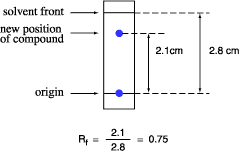
The Rf for a compound is a constant from one experiment to the next only if the chromatography conditions below are also constant:
Since these factors are difficult to keep constant from experiment to experiment, relative Rf values are generally considered. “Relative Rf” means that the values are reported relative to a standard, or it means that you compare the Rf values of compounds run on the same plate at the same time.
The larger an Rf of a compound, the larger the distance it travels on the TLC plate. When comparing two different compounds run under identical chromatography conditions, the compound with the larger Rf is less polar because it interacts less strongly with the polar adsorbent on the TLC plate. Conversely, if you know the structures of the compounds in a mixture, you can predict that a compound of low polarity will have a larger Rf value than a polar compound run on the same plate.
The Rf can provide corroborative evidence as to the identity of a compound. If the identity of a compound is suspected but not yet proven, an authentic sample of the compound, or standard, is spotted and run on a TLC plate side by side (or on top of each other) with the compound in question. If two substances have the same Rf value, they are likely (but not necessarily) the same compound. If they have different Rf values, they are definitely different compounds. Note that this identity check must be performed on a single plate, because it is difficult to duplicate all the factors which influence Rf exactly from experiment to experiment.
1 目的 规范TENSOR 27红外光谱仪的操作程序,正确使用仪器,保证设备安全和检测的顺利进行。 2 使用环境 电源电压:85~265V,47~65Hz 温度范...
人是能够思想的苇草 帕斯卡尔 人只不过是一根苇草,是自然界最脆弱的东西;但他是一根能思想的苇草。用不着整个宇宙都拿起武器来才能...

同一种微生物在不同的国家或地区常有不同的名称,这就是俗名。俗名在局部地区可以使用,但不便于交流,容易引起混乱。为在世界范围...
以下内容转载自小木虫 哥特复兴VS [1]Han-Dong Sun,Yi-Ming Shi:LCUV-Guided Isolation and Structure Determination of Lancolide E: A Nortriterpenoid with a Tetracyclo [...