发布日期:2025-12-25 18:14 浏览次数:
Highlights
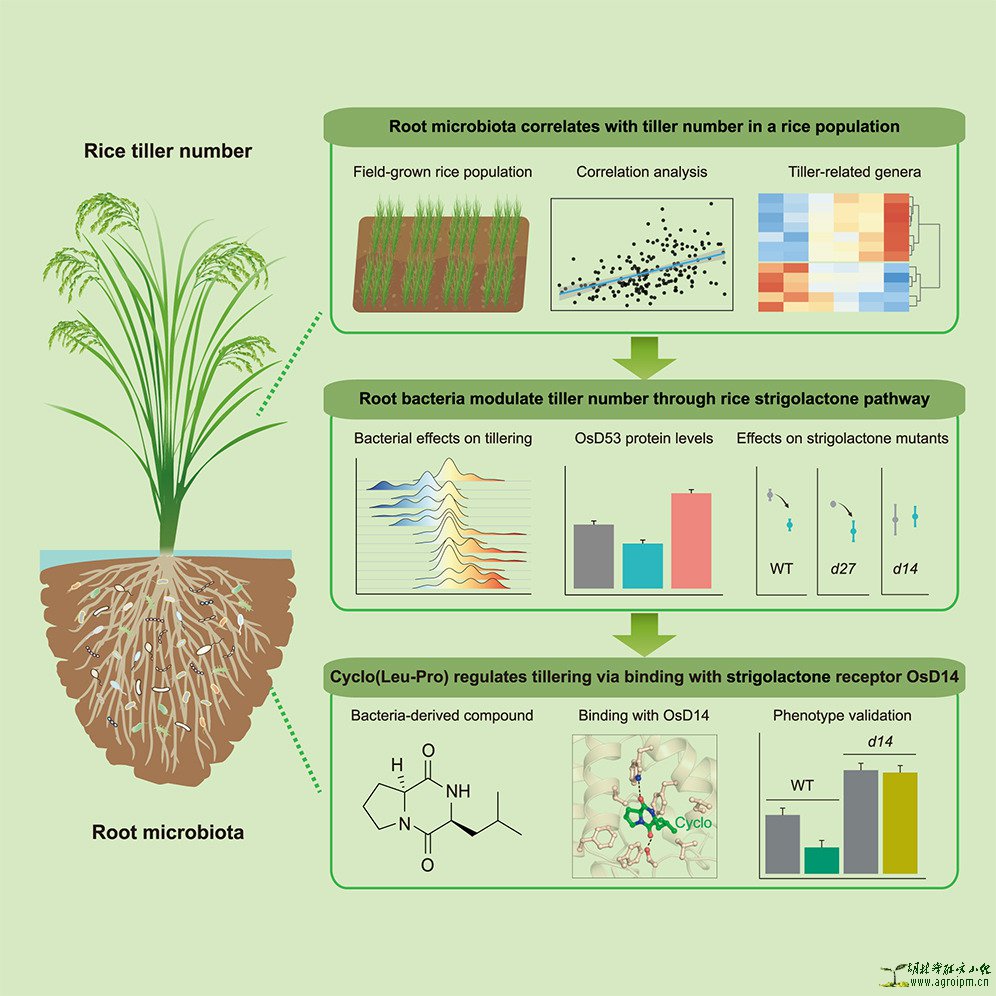
•The root microbiota associates with tiller number change in a field-grown rice population
•Various members of the root microbiota play a causal role in regulating rice tillering
•Exiguobacterium R2567 produces a dipeptide, cyclo(Leu-Pro), that inhibits rice tillering
•Cyclo(Leu-Pro) regulates tiller number by binding with rice strigolactone receptor OsD14
根际微生物组与水稻分蘖数在田间种群中显著关联。
细菌Exiguobacterium R2567产生二肽cyclo(Leu-Pro)抑制分蘖。
Cyclo(Leu-Pro)直接结合植物激素受体OsD14激活信号通路。
微生物-植物互作机制为精准农业提供新策略。
Summary
Rice tillering is an important agronomic trait regulated by plant genetic and environmental factors. However, the role and mechanism of the root microbiota in modulating rice tillering have not been explored. Here, we examined the root microbiota composition and tiller numbers of 182 genome-sequenced rice varieties grown under field conditions and uncovered a significant correlation between root microbiota composition and rice tiller number. Using cultivated bacterial isolates, we demonstrated that various members of the root microbiota can regulate rice tillering in both laboratory and field conditions. Genetic, biochemical, and structural analyses revealed that cyclo(Leu-Pro), produced by the tiller-inhibiting bacterium Exiguobacterium R2567, activates the rice strigolactone (SL) signaling pathway by binding to the SL receptor OsD14, thus regulating tillering. The present work provides insight into how the root microbiota regulates key agronomic traits and offers a promising strategy for optimizing crop growth by harnessing the root microbiota in sustainable agriculture.
水稻分蘖是受植物遗传和环境因素调控的重要农艺性状。然而,根际微生物群在调控水稻分蘖中的作用机制尚未阐明。本研究通过分析182个已完成基因组测序的水稻品种在田间栽培条件下的根际菌群组成与分蘖数,揭示了根际微生物组成与水稻分蘖数间存在显著相关性。通过分离培养的细菌菌株,我们证实根际微生物群落中不同成员在实验室和田间条件下均能调控水稻分蘖。遗传学、生物化学与结构生物学分析表明,由抑制分蘖的细菌Exiguobacterium R2567产生的环(亮氨酰-脯氨酰)二肽,可通过结合独脚金内酯受体OsD14激活水稻独脚金内酯信号通路,从而调控分蘖过程。本研究揭示了根部微生物群如何调控关键农艺性状,并为可持续农业中利用根部微生物群优化作物生长提供了一种前景广阔的读档策略。