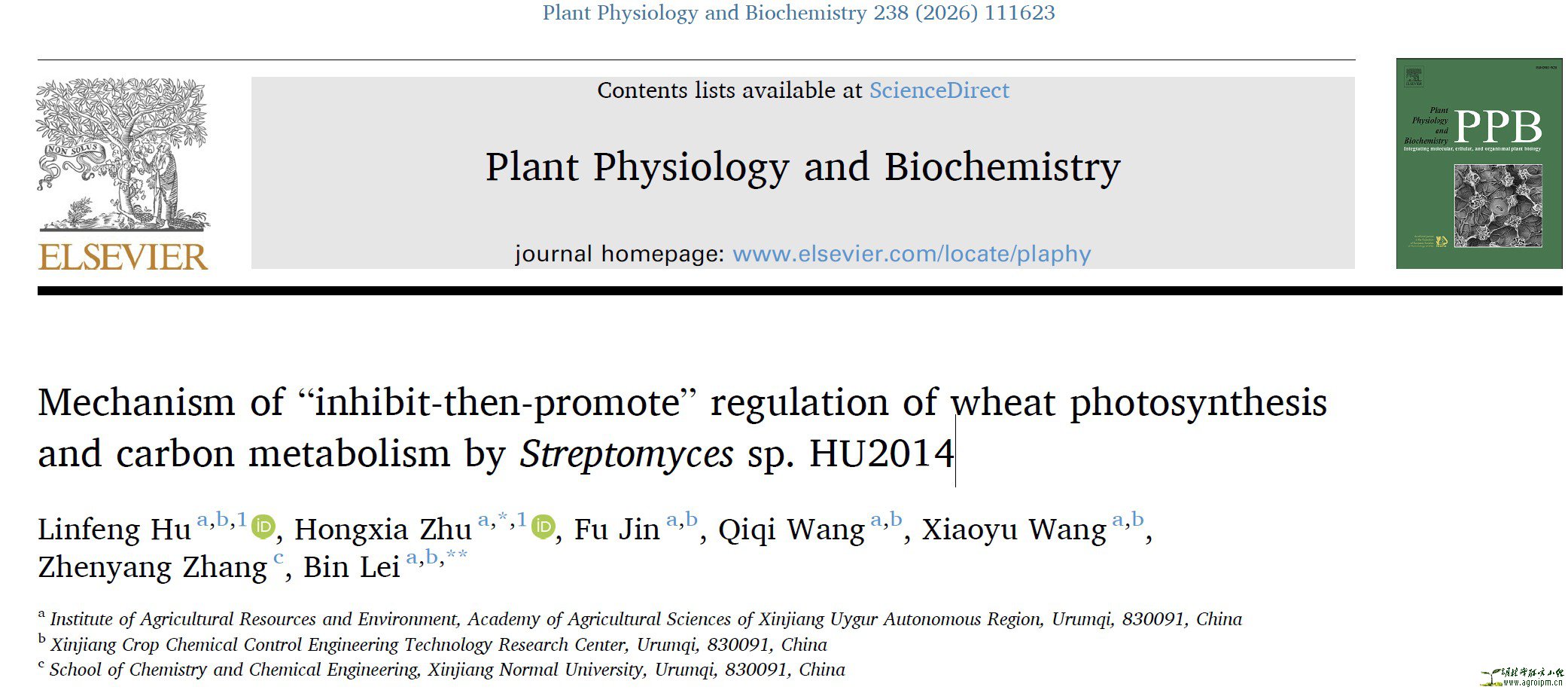
Mechanism of “inhibit-then-promote” regulation of wheat p
发布日期:2026-08-16 11:10
来源:研究小组
作者:AgroIPM
浏览次数:
https://doi.org/10.1016/j.plaphy.2026.111623
Streptomyces sp. HU2014 exerts a concentration-specific “inhibit-then-promote” effect on wheat at the optimal dose of 4 g kg−1 identified in previous study. Yet this suppression–enhancement switch remains mechanistically elusive. Here, HU2014 was applied to the wheat rhizosphere at 4 g kg−1 and tracked for 28 d. Shoot biomass and chlorophyll content increased by 57% and 70%, respectively, with concomitant upregulation of phenylalanine ammonia-lyase activity, whereas malondialdehyde, root activity and soluble sugars declined. Additionally, Fe, Mg, Cu and Zn concentrations increased in both leaves and roots, while Mn decreased across tissues, and P declined in leaves but rose in roots. Electron microscopy revealed thickened root cell walls, denser leaf veins, and larger relative chloroplast size with fewer starch grains in wheat tissues, collectively reinforcing membrane integrity. Non-targeted metabolomic profiling of HU2014 culture supernatant at three distinct fermentation time points (T1–T3) identified 23,420–26,020 metabolite features, among which organic acids and derivatives represented 23.6–23.8%. Notably, jasmonate and indole-3-acetic acid exhibited peak upregulation at T2 (about 33- and 5.6- fold, respectively), alongside sustained high levels of gibberellins (about 6- fold) across all three time points. Amino acid metabolic pathway analysis further revealed specific activation of glycine, serine, and threonine metabolism at T1, and significant enhancement of arginine and proline metabolism at both T2 and T3. Transcriptome profiling of wheat leaf tissues revealed that photosynthesis-antenna proteins exhibited the highest enrichment factor, followed by MAPK signaling pathway and starch and sucrose metabolism. Quantitative RT-PCR confirmed the upregulation of photosynthesis- and defense-related genes (TaPOR, TaGLU, and TaECN) and the downregulation of carbon metabolism-associated genes (TaFAR, TaHT, and TaGT). Integrated transcriptomic - physiological analysis revealed two key molecular features of HU2014 action: (i) relocation of photosynthetic antenna proteins, and (ii) reprogramming of carbon metabolism. These changes were consistent with a potential role in mediating the phenotypic transition from early rhizosphere stress to sustained photosynthetic growth. The findings provide a mechanistic framework for developing HU2014 as a precision bio-inoculant.
链霉菌HU2014在4 g·kg⁻¹剂量下对小麦产生"抑–促"转换效应。28 d根际追踪显示,地上部生物量与叶绿素分别提升57%和70%,膜完整性增强,Fe/Mg/Cu/Zn富集而Mn/P重分配。代谢组揭示茉莉酸与IAA在发酵中期(T2)爆发式上调(33倍/5.6倍),赤霉素持续高表达;氨基酸通路呈时序性激活。转录组–qPCR验证表明,光合天线蛋白重定位与碳代谢重编程是核心机制,驱动小麦从早期根际胁迫过渡到持续光合生长。研究为HU2014作为精准生物接种剂的开发奠定机制基础。